
 How It Works: Meet the Parts That Make Your Gas Furnace Work
We’ve talked about how heating equipment works to warm your home, but we haven’t properly introduced the components that work together in precise order to make that happen. There are lots of moving parts and we’d like to help them make sense to you!
When you turn up your thermostat on a cold winter morning, the result seems pretty simple: Push the right button, warm air comes out of the vents.
But inside your furnace, several components have to do their jobs—in the right order—before that warmth reaches you.
Modern furnaces aren’t designed to simply turn on the gas and hope for the best. They go through a carefully controlled sequence that helps make sure combustion is happening properly and heat is being produced safely.
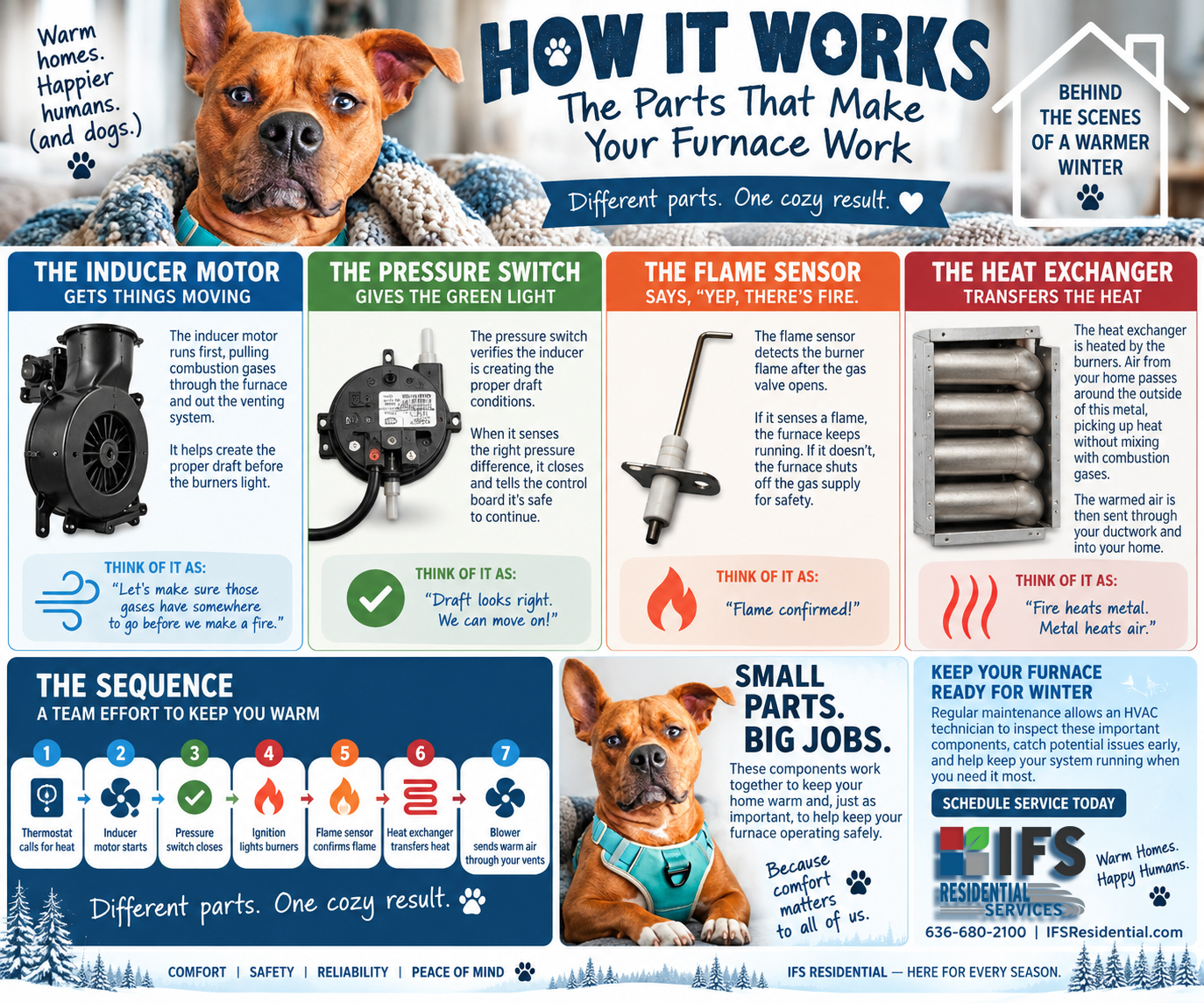
Let’s meet a few of the important players: the inducer motor, pressure switch, flame sensor, and heat exchanger.
Step 1: The Inducer Motor Gets Things Moving
Your thermostat realizes the house is colder than the temperature you’ve selected and sends a request for heat to the furnace.
One of the first things you’ll usually hear is a small motor starting up.
That’s the inducer motor.
Before the furnace lights its burners, the inducer helps establish the airflow needed to move combustion gases through the furnace and toward the venting system.
Think of it as the furnace saying:
“Before we make a fire, let’s make sure those combustion gases have somewhere to go.”
But the furnace doesn’t just assume the inducer is doing its job. That’s where our next component comes in.
Step 2: The Pressure Switch Gives the Green Light
The pressure switch is a safety device that helps verify that the furnace has the proper draft conditions before allowing the ignition sequence to continue.
When the inducer motor creates the expected pressure difference, the pressure switch closes.
That tells the furnace control board, essentially:
“Draft looks right. We can move on.”
If the pressure switch doesn’t close when it’s supposed to, the furnace should not proceed with ignition.
Several things can prevent it from closing properly, including problems with the inducer, venting, tubing, condensate drainage on some furnaces, or the pressure switch itself.
That’s why simply bypassing a pressure switch is not a repair. It’s part of the furnace’s safety system, and this kind of failure needs to be properly diagnosed.
Step 3: It’s Time for Fire
Once the furnace has confirmed that the proper conditions are present, it can begin the ignition process.
Depending on the furnace, an igniter heats up or another ignition system prepares to light the burners. The gas valve opens, gas reaches the burners, and — We have flame.
But there’s another important question:
How does the furnace know the burners actually lit?
Meet the flame sensor.
Step 4: The Flame Sensor Says, “Yep, There’s Fire.”
The flame sensor is a small but extremely important safety component.
Its job is exactly what the name suggests: it confirms that a flame is actually present after the furnace opens the gas valve.
If the flame sensor detects the burner flame, the furnace can continue operating.
If it doesn’t detect a flame, the furnace shuts off the gas supply rather than allowing unburned gas to continue flowing.
A dirty or failing flame sensor can cause frustrating symptoms. Homeowners sometimes notice:
The furnace starts>The burners ignite>A few seconds later…the burners shut back off.
The furnace may try the sequence again before eventually stopping and displaying or storing a fault code.
The furnace isn’t necessarily “randomly shutting off.” Its safety controls may be doing exactly what they’re designed to do.
Step 5: The Heat Exchanger Transfers the Heat
Now we’re actually making heat—but we don’t want the combustion gases mixing with the air you’re breathing.
That’s the job of the heat exchanger.
The burners heat the metal heat exchanger. Air from your home passes around the outside of that hot metal, picking up heat (through heat transfer) without directly mixing with the combustion gases traveling through the heat exchanger.
The warmed household air is then sent through your ductwork and out of the supply vents.
Meanwhile, the combustion gases remain on their own path and are vented outside.
In simple terms:
Fire heats metal.
Metal heats air.
The blower sends that warm air into your home.
That separation is one reason the condition of a heat exchanger is so important. Damage or deterioration requires professional evaluation because the heat exchanger is part of the furnace’s combustion and venting system.
So How Does It All Work Together?
Think of your furnace less like one big heater and more like a team completing a checklist.
- Thermostat: “We need heat!”
- Inducer Motor: “I’ll establish draft.”
- Pressure Switch: “Draft conditions check out.”
- Ignition System: “Let’s light the burners.”
- Flame Sensor: “Flame confirmed.”
- Heat Exchanger: “I’ll transfer that heat to the home’s air.”
- Blower: “I’ll take it from here.”
And finally…
Warm air reaches you!
All of this happens automatically, usually within seconds.
Small Parts. Big Jobs.
Your furnace might look like one big metal box, but inside is a carefully coordinated system of motors, switches, sensors, controls, burners, and safety devices.
When everything is working properly, you probably don’t think about any of them. You adjust the thermostat and your house gets warmer.
That’s exactly how it should be.
But when one part of that sequence doesn’t behave the way the furnace expects, the system may stop heating—even when the component that actually creates the heat isn’t the problem.
That’s why professional diagnosis matters. A furnace that won’t stay lit could have a completely different issue from one that never lights at all.
And many of these components aren’t just about comfort. They’re part of the system designed to help your furnace operate safely.
Keep Your Furnace Ready for Winter
Regular preventative maintenance gives an HVAC technician an opportunity to inspect furnace operation, check important components and safety controls, and catch potential problems before you’re depending on your furnace during the coldest night of the year.
Because when it’s freezing outside, you don’t really want to know what your inducer motor, pressure switch, flame sensor, or heat exchanger is doing.
You just want to hear that furnace kick on and feel warm air coming through the vents.
IFS Residential can help keep it that way.
For furnace maintenance, repairs, or questions about your home’s heating system, give IFS Residential a call at 636-680-2100.
Stay warm—and we’ll keep the complicated stuff in the mechanical room.
Leave a Reply